If you’ve been in the flexible packaging industry for long, you’ve probably walked into a plant, felt a micro-perforated film rustle in your hands, and wondered how it’s made. And if you’re working with mono layer film blowing machines, one of the most common questions we get from customers is this: Can a mono layer film blowing machine actually produce micro-perforated films? The short answer is yes—but the details matter. As a supplier who’s fielded this question hundreds of times over the last 12 years, I’ve seen first-hand how many manufacturers write off mono layer machines as too limited for specialty films like these, and how many of them miss out on cost-saving opportunities because of that assumption. Let’s break this down, no overly technical jargon, just real talk about what works, what doesn’t, and how to make it work for your operation. Mono Layer Film Blowing Machine
First, let’s define what micro-perforated films actually are, because that term gets thrown around a lot and not everyone agrees on the fine print. For our purposes here, micro-perforated films are thin plastic films (usually 10 to 100 microns thick) with tiny holes—typically 50 to 500 microns in diameter, so smaller than the tip of a standard ballpoint pen—spaced evenly across the surface at densities of 100 to 10,000 holes per square meter. The uses are everywhere: produce packaging, where the holes let ethylene gas escape so vegetables stay fresh longer; bread and baked goods packaging, to prevent sogginess; even certain medical packaging, where controlled air flow is critical. The traditional way most people make these, at least as I was taught early in my career, is to run two separate processes: first blowing a mono layer film, then running it through a secondary perforation line with needles, lasers, or mechanical punches. That extra step adds time, labor, and cost, which is why so many of our customers are asking if they can skip it.
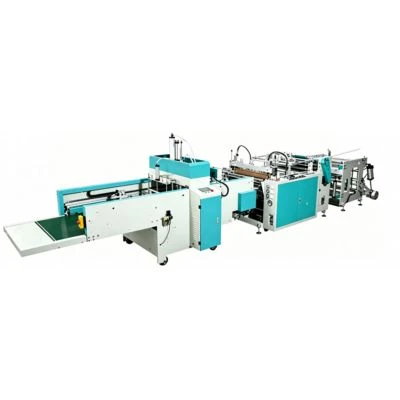
Now, how do you modify a standard mono layer film blowing machine to do this? The key isn’t just the extruder unit—it’s the integrated perforation system mounted right on the line, after the film is blown and cooled but before it’s wound up. Let’s go through the basics of a standard mono layer line to set the stage: you have a resin hopper feeding an extruder, which melts the plastic (usually LDPE, LLDPE, or a blend, since those are the most flexible and easiest to perforate), then the melt goes through a die head that forms a tube of film, that tube is inflated with air to its final thickness, cooled with air rings, flattened between nip rollers, and then wound onto a roll. The sweet spot for adding a perforation module is right after the nip rollers, when the film is still slightly taut and free of the wrinkles that mess with hole consistency.
But here’s where you have to be careful: not all perforation methods work equally well with a mono layer line’s production speed and film thickness. The two most common integrated systems we install are micro-needle perforation and laser perforation, and each has its pros and cons for mono layer setups. Let’s start with micro-needle, which is the most budget-friendly option for smaller to mid-sized operations. The system uses a rotating cylinder studded with tiny, sharp needles; as the film passes between this cylinder and a smooth pressure roller, the needles pierce through the film to create the holes. For mono layer films, this works best with flexible resins like LDPE, because stiffer resins (like HDPE) tend to tear instead of puncture cleanly. The biggest mistake we see customers make here is trying to use too large of needles or too high of a line speed. If you run a standard mono layer line at 80 meters per minute, the needle cylinder has to spin fast enough to match that speed to keep hole spacing even—if it lags even a little, you get overlapping holes or gaps, which ruins the film.
Then there’s laser perforation, which is a more precise option, especially for higher production volumes. Instead of physical needles, a series of laser beams burns tiny holes into the film, and you can adjust the hole size, shape, and density right from a control panel, no need to change physical parts. For mono layer lines, laser perforation is ideal because it works on almost any resin—even the stiffer ones like LLDPE blends that needle systems struggle with—and it doesn’t put physical stress on the film, so you get fewer tears or edge defects. The downside is upfront cost; a laser module is more expensive than a needle system, but for plants running 150+ meters per minute, the lower error rate and less downtime for part changes usually balance that out within a couple years.
Now, let’s address the elephant in the room: what are the limitations? A mono layer film blowing machine can’t do everything, and we’re honest about that with every customer. For example, if you’re trying to make micro-perforated films with hole sizes smaller than 50 microns, most standard integrated systems can’t keep up with consistency without major modifications—you’d need a higher-precision laser or a specialized micro-needle cylinder, which is a separate add-on. Also, if you’re working with a multi-layer film (like a co-extruded film with sealant and structural layers), a mono layer line won’t handle that at all, which is what leads some people to think mono layer lines can’t do perforation. But for 90% of the micro-perforated film applications our customers care about—produce packaging, bakery wrap, garment bags, even some agricultural mulch films—mono layer is more than capable.
I should also mention a common myth I hear all the time: that integrated perforation ruins the film’s mechanical properties, like tensile strength or sealability. That’s only true if you set the perforation system up wrong. If the holes are too dense, they can weaken the film enough to tear during packaging or transportation, but with the right settings—hole spacing, depth, and size tailored to the resin and application—micro-perforated mono layer films actually perform just as well as non-perforated ones, sometimes better because the controlled air flow prevents moisture buildup. We’ve got a customer in the Midwest that runs 120 metric tons of micro-perforated produce film a month on a 60-meter line, and they haven’t had a single return because of film failure in three years. That’s not an anomaly; that’s a well-set-up mono layer line doing exactly what it’s designed for.
So, what does it take to make this work for your operation? It starts with matching the machine’s specifications to your specific film needs. If you’re a small to mid-sized plant running 50 to 80 meters per minute, a mono layer line with a micro-needle perforation module is going to give you the best return on investment, with the lowest upfront cost and easy maintenance. If you’re a larger plant with higher volume needs, a laser-integrated line is going to save you money on labor and downtime, since you don’t have to stop to change needles or adjust parts as often.
Another key factor is resin selection. As I mentioned earlier, LDPE is the most common resin for mono layer micro-perforated films because it’s flexible, melts evenly, and punctures cleanly. LLDPE works well too, especially if you need a film with a bit more strength for heavy-duty applications, but you may need to adjust the perforation system’s pressure slightly to get a clean hole without tearing. HDPE is trickier with standard systems, but if you’re set on HDPE for its durability, we can work with you to upgrade the perforation module to handle stiffer resins.
I’ve also seen customers get tripped up by line speed. A standard mono layer line can run much faster than people realize—some of our models top out at 150 meters per minute, which is more than enough for high-volume micro-perforated production. The mistake is pairing a slow line with a high-speed perforation system, or vice versa. We always work with customers to calculate their required line speed, hole density, and resin type before recommending a setup, because a one-size-fits-all approach doesn’t work here.
Let me give you a real example to make this concrete. A customer I worked with two years ago was running a separate line for non-perforated film and a second, dedicated line for perforated film, costing them $18,000 a month in extra labor and energy. They came to us asking if their existing mono layer line could be converted, and we installed a 200-microneedle perforation module right after the nip rollers. They switched production over in two weeks, and now they make micro-perforated films on the same line, cutting their monthly costs by 45% and increasing their output because they don’t have to move film between two lines anymore. That’s the kind of win I love to see from this technology—turning a machine you already own into a multi-purpose workhorse.
Now, let’s talk about when a mono layer line isn’t the right fit, because we’re not here to oversell. If you need micro-perforated films with hole sizes larger than 500 microns (like for some compostable bag applications) or densities higher than 10,000 holes per square meter, a mono layer line might not be the most efficient choice, since those parameters can lead to excessive tearing or inconsistent hole placement. Also, if you’re working with specialty resins like biodegradable PLA that require very precise perforation settings, you may need a slightly modified laser system, which we can provide, but it’s still compatible with a standard mono layer line, just with a few adjustments.
Another point to consider: quality control. Integrated perforation on a mono layer line lets you catch defects in real time, right when the film is being produced, instead of waiting until after the secondary perforation line. That means less scrap, since you don’t have to discard entire rolls of perfectly good film because of a perforation error. We’ve seen scrap rates drop by as much as 20% for customers who switch from a two-line setup to an integrated mono layer line, which adds up to big savings over a year.
So, to circle back to the original question: Can a mono layer film blowing machine produce micro-perforated films? Absolutely—when configured correctly with the right perforation module, matched to your resin and production needs. The days of thinking mono layer lines are only for basic, non-perforated films are long gone, and more manufacturers are realizing that adding an integrated perforation system is one of the easiest ways to expand their product line without investing in a whole new line.
If you’re currently producing micro-perforated films on a secondary line, or you’re looking to add that product to your catalog without the overhead of a dedicated line, let’s talk. We can walk through your current setup, your target film specifications, and help you design a mono layer film blowing system that fits your budget and production goals. Don’t let outdated assumptions limit your product range—micro-perforated films are within reach with the right equipment.
Bag Making Machine References
- The Wiley Encyclopedia of Packaging Technology, 3rd Edition, John Wiley & Sons, 2009
- Polymer Engineering & Science, Volume 52, Issue 10, "Perforation Mechanics of Thin Flexible Polymer Films", 2012
- Flexible Packaging Association, "Trends in Converting Integrated Packaging Systems", 2021
- Journal of Plastic Film & Sheeting, "Performance Characteristics of Micro-Perforated Mono Layer LDPE Films for Fresh Produce Packaging", 2018
Ruian Jianhao Precision Machinery Co., Ltd.
As one of the most professional mono layer film blowing machine manufacturers and suppliers in China, we’re featured by quality products and good price. Please rest assured to wholesale durable mono layer film blowing machine for sale here from our factory. Welcome to contact us for customized service and quotation.
Address: No. 8, Jianshe Road, Beiyu Village, Shangwang Street, Ruian City, Wenzhou City, Zhejiang Province
E-mail: 1832333027@qq.com
WebSite: https://www.jianhaomachinery.com/
