In the realm of electric motors, brushless DC (BLDC) motors stand out due to their efficiency, reliability, and low maintenance. These motors have found their way into a vast array of applications, from automotive systems and aerospace components to consumer electronics and industrial machinery. One of the key aspects of understanding and optimizing BLDC motors is the commutation process. As a leading supplier of Brushless DC motors, I am excited to delve into the different types of commutation in BLDC motors. Brushless Dc Motor
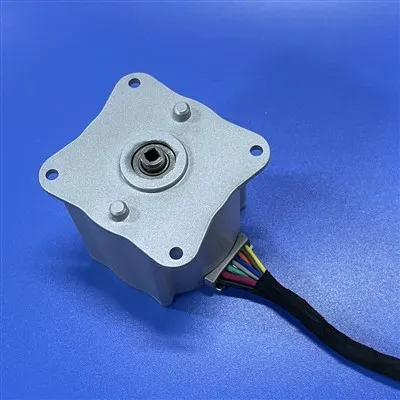
Introduction to Commutation in BLDC Motors
Before we jump into the types of commutation, let’s understand what commutation is in the context of BLDC motors. In an electric motor, the magnetic field in the stator and the rotor must interact in a specific way to produce rotation. Commutation is the process of switching the current in the stator windings at the right time to continuously generate a rotating magnetic field that keeps the rotor turning.
Unlike traditional brushed DC motors, where the commutator and brushes physically switch the current flow, BLDC motors use electronic commutation. This eliminates the wear and tear associated with brushes, resulting in a longer lifespan and higher efficiency.
Sensor – Based Commutation
Hall – Effect Sensor Commutation
Hall – effect sensors are one of the most common methods of sensor – based commutation in BLDC motors. These sensors detect the magnetic field of the rotor and provide signals to the motor controller. The controller uses these signals to determine the position of the rotor and then switches the current in the stator windings accordingly.
The Hall – effect sensors are typically placed around the stator, and they can be configured in a three – phase system for BLDC motors. Each sensor provides a digital output that indicates the presence or absence of a magnetic field. By analyzing the signals from the three sensors, the controller can determine the exact position of the rotor within a 60 – degree electrical angle.
One of the main advantages of Hall – effect sensor commutation is its simplicity and reliability. The sensors are relatively inexpensive and easy to install. They also provide a high – level of accuracy in rotor position detection, which is crucial for smooth motor operation. However, the presence of sensors adds to the cost and complexity of the motor system, and they can be sensitive to temperature and magnetic interference.
Encoder – Based Commutation
Encoders are another type of sensor used for commutation in BLDC motors. There are two main types of encoders: incremental and absolute.
Incremental encoders provide information about the change in the rotor’s position. They generate a series of pulses as the rotor rotates, and the number of pulses can be used to calculate the angular displacement of the rotor. The direction of rotation can also be determined by analyzing the phase relationship between two sets of pulses.
Absolute encoders, on the other hand, provide the exact position of the rotor at any given time. They use a unique code pattern to represent each position, which allows for precise position control.
Encoder – based commutation offers high – resolution position feedback, which is beneficial for applications that require precise speed and position control, such as robotics and CNC machines. However, encoders are more expensive than Hall – effect sensors, and they require more complex signal processing.
Sensorless Commutation
Back – EMF Sensing
Back – electromotive force (back – EMF) sensing is the most common method of sensorless commutation in BLDC motors. When the rotor of a BLDC motor rotates, it induces a back – EMF in the stator windings. The back – EMF is proportional to the speed of the rotor and the strength of the magnetic field.
The motor controller can measure the back – EMF in the non – energized stator winding to determine the position of the rotor. When the back – EMF crosses a certain threshold, the controller switches the current in the stator windings to maintain rotation.
Back – EMF sensing has several advantages. It reduces the cost and complexity of the motor system by eliminating the need for sensors. It also makes the motor more compact and reliable. However, this method has limitations at low speeds because the back – EMF is very small and difficult to measure accurately. Additionally, it may require more sophisticated algorithms to compensate for variations in motor parameters.
Inductive Sensing
Inductive sensing is another approach to sensorless commutation. It relies on the principle that the inductance of the stator windings changes as the rotor rotates. By measuring these changes in inductance, the motor controller can determine the position of the rotor.
Inductive sensing has the potential to provide accurate position information at low speeds, which is an advantage over back – EMF sensing. However, it requires additional hardware to measure the inductance, and the performance can be affected by factors such as temperature and magnetic interference.
Flux Estimation
Flux estimation methods use mathematical models to estimate the magnetic flux in the motor. By analyzing the estimated flux, the controller can determine the position of the rotor. These methods are often based on the motor’s electrical equations and require accurate knowledge of the motor’s parameters.
Flux estimation can provide good performance over a wide range of speeds, but it is computationally intensive and requires precise modeling of the motor. Any errors in the motor model can lead to inaccurate position estimation.
Comparison of Different Commutation Methods
When choosing a commutation method for a BLDC motor application, several factors need to be considered.
Sensor – based commutation methods, such as those using Hall – effect sensors or encoders, offer high – accuracy position detection. They are suitable for applications that require precise speed and position control, such as servo systems. However, the additional cost and complexity of the sensors can be a drawback, especially in cost – sensitive applications.
Sensorless commutation methods, on the other hand, reduce the cost and complexity of the motor system. Back – EMF sensing is the most widely used sensorless method, but it has limitations at low speeds. Inductive sensing and flux estimation can overcome some of these limitations, but they require more complex hardware and algorithms.
Our Role as a Brushless DC Motor Supplier
As a supplier of Brushless DC motors, we understand the importance of choosing the right commutation method for each application. We offer a wide range of BLDC motors with different commutation options to meet the diverse needs of our customers.
Our engineering team has extensive experience in designing and optimizing BLDC motors for various applications. We can help our customers select the most suitable commutation method based on their specific requirements, such as speed range, accuracy, cost, and environmental conditions.

We also provide technical support and after – sales service to ensure that our customers can get the most out of our motors. Whether you are working on a small consumer electronics project or a large – scale industrial application, we have the expertise and products to meet your needs.
Contact Us for Procurement and洽谈
Medical Brushless Motor If you are interested in our Brushless DC motors or have any questions about commutation methods, we encourage you to contact us. Our sales team is ready to discuss your requirements and provide you with detailed product information and quotations. We look forward to the opportunity to work with you and contribute to the success of your projects.
References
- Krause, P. C., Wasynczuk, O., & Sudhoff, S. D. (2002). Analysis of electric machinery and drive systems. Wiley – Interscience.
- Miller, T. J. E. (1989). Brushless permanent – magnet and reluctance motor drives. Oxford University Press.
- Bolton, W. (2006). Mechatronics: electronic control systems in mechanical and electrical engineering. Newnes.
Shenzhen HengDrive Technologies Co., Ltd.
Shenzhen HengDrive Technologies Co., Ltd. is one of the most professional brushless dc motor manufacturers and suppliers in China, specialized in providing high quality customized service. We warmly welcome you to buy the newest brushless dc motor in stock here from our factory.
Address: Building A & F, FuNing Hi-Tech Park, XinTian Road, FuHai Street, BaoAn District, ShenZhen, GuangDong Province, China.
E-mail: Marketing001@hengdrive.com
WebSite: https://www.hengdrivemotor.com/
